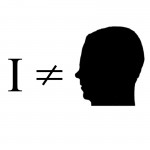
 We are not Cartesian egos. We are not biological organisms either.
Not Cartesian egos
A Cartesian ego is a kind of mental or spiritual thing that is thought to inhabit a human body and give it life. Many people believe we can exist independently of a human body – that we survive the death of our bodies, continuing to have experiences either without a body, or by being reborn in another body.
I hardly need to argue against Cartesian egos. The idea is in widespread disrepute without any assistance from me. It is hard to reconcile with a scientific view of the world. We have no convincing evidence that such things exist. Until we have, we should use Occam’s Razor for its intended purpose to prune them from our conceptual scheme. Leaving them in creates clutter and awkward problems.
One problem comes from split brain research. When the corpus callosum connecting a patient’s two cerebral hemispheres is cut, two centres of consciousness appear where there was one before. Should we conclude that the surgeon’s knife divided a spiritual substance? Instead of deepening our understanding, this multiplies mysteries.
Despite its academic unrespectability, the idea that we are Cartesian egos is embraced by billions of people. It is deeply involved with emotion, as this passage from Umberto Eco’s novel The Mysterious Flame of Queen Loana illustrates:
One evening the spiritual director stood in front of the altar balustrade, illuminated – like all of us, like the entire chapel – by that single candle that haloed him in light, leaving his face in darkness. Before dismissing us, he told us a story. One night, in a convent school, a girl died, a young, pious, beautiful girl. The next morning, she was stretched out on a catafalque in the nave of the church, and the mourners were reciting their prayers for the deceased, when all of a sudden the corpse sat up, eyes wide and finger pointing at the celebrant, and said in a cavernous voice, “Father, do not pray for me! Last night I had an impure thought, a single thought – and now I am damned!” Continue reading “What We Are Not”

 Imagine, in the early days of books, a small library consisting entirely of original manuscripts. Some of them are very old, and have been attacked by mice. Some have deteriorated so much that their pages crumble to dust when the custodian of the library tries to read them. He mourns the loss of these books, and contemplates the inevitable decay of the remaining books with sorrow. To be sure, new manuscripts are occasionally added to the library, but they cannot replace the volumes that are lost forever. This goes on until, one day, the young assistant librarian has an idea. “This book will be unreadable in five years,” he tells his elder. “But I can read it now. If I copy the words of this book onto sheets of new vellum, and bind them in a strong new binding, we will be able to read it for many decades to come.” The old librarian tenderly strokes the cracked spine of the crumbling volume, and shakes his head. “What good is a copy? It wouldn’t be the same book.”
  Part Three of
  In the
  In my story Forking, Elliot Otley is accidentally duplicated. During part of the story, each Elliot regards his counterpart as another man. Later, he comes to regard the other Elliot as himself. The difference between those two attitudes is dramatic.
 All that’s needed to make a case for radical reform of the idea of self is a thought-experiment with a clear and compelling outcome. However, the world is full of people who pay no attention to thought-experiments, however revealing they may be in exposing inconsistencies in everyday ideas, because thought-experiments aren’t ‘real’. These are people from Missouri, as the saying goes, who demand to be shown. And I have nothing to show, yet.
 In recent weeks, I have been devouring
  This post is an overview of the Phantom Self project, as I conceive it at the outset. It presents an overall structure of my case for conceptual reform. It does not state the entire argument, as most supporting detail will be left to subsequent posts. It is a plan and a rough map, not the journey itself, in the course of which there will certainly be unscheduled detours.
 An exchange of letters between Ian Brown and Jean Vanier was published in the Globe and Mail of Feb. 21, 2009, under the headline, “