Tick…tick…tick—a reply to Ian Brown

Ship's clock(small)I like Ian Brown’s birthday pieces—about turning 55 in 2009, now 60 in Feb 8th’s Globe and Mail—because they so eloquently express the feelings that come naturally to people on their birthdays, starting around age 30: the sense of time running out, the vision of one’s remaining life as a diminishing resource, the fear that its quality will deteriorate.  He writes:

I began my 60th birthday underslept, with a brewing chest infection, and…not at all pleased to have reached the milestone—standing as I was on the threshold of the no-man’s land beyond sixty. Sixty! I mean, Jesus wept: How did I get to be this old? Continue reading “Tick…tick…tick—a reply to Ian Brown”

The Human Kludge

Human Kludge (glowing edges)Natural selection—Richard Dawkins’ ‘blind watchmaker’—has come up with some remarkable designs over four billion years. Those that persisted are, to a greater or lesser extent, effective responses to evolutionary pressures. But many of these design solutions are far from optimal. Natural selection is an opportunist, whose default move is to recombine existing resources, cobbling something together from bits of earlier work rather than redesign from the ground up.

When I worked in software development, it was our default move too. Most programmers don’t mind describing themselves as “lazy.” Reinventing the wheel is rarely the best solution, if you have a library of previously developed, de bugged, tested implementations of rims, axles, and drive trains that have seen a few years of revenue service. Programmers like to re-use their old code because they know it works. Also, it’s usually the fastest way to meet a deadline. “Lazy” can be efficient and smart.

Although they may perform reliably, solutions assembled out of a hodgepodge of old components rarely look as nice as if someone had time to sit down and design them from scratch. And because the components were not originally made to work together , there is a greater risk of unintended side effects.

The Free On-line Dictionary defines a “kludge” (pronounced “klooj”) as:

1. A system, especially a computer system, that is constituted of poorly matched elements or of elements originally intended for other applications.

2. A clumsy or inelegant solution to a problem.

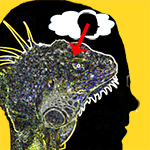
Close scrutiny of the human motivational system reveals a kludgy design. A uniquely human, state-of-the-art module for visualizing and planning the future was bolted on to the emotional apparatus of an iguana. The result works, but not well. On the whole it has been hugely adaptive, allowing us humans to flourish, multiply, and dominate our planet, outcompeting all other large species. But it is far from optimal, often working against itself, driving behaviour that is not at all adaptive either for the individuals involved or for our species as a whole. Moreover, it has unpleasant side effects.

In this post I will outline a theory of this design: how it came to be, its primary components, and why it works as well as it does. I will also lay out some of its shortcomings, and recommend an alternative, improved solution. Continue reading “The Human Kludge”

Anatta to Agape – Mark Johnston’s Surviving Death

In a remarkable book, Surviving Death, Mark Johnston reaches several surprising conclusions about persons and personal identity. One of them, as the title implies, is that persons can survive their biological deaths. This claim does not depend on the existence of anything resembling an immaterial, substantial soul; Johnston’s account of post-death survival is entirely naturalistic.

Johnston has packed a lot into five long chapters, originally presented as a Carl G. Hempel lecture series at Princeton. I am impressed by the stamina of the audience, who attended to what must have been a full week of close and often counterintuitive argument and stayed to ask penetrating questions. I doubt I could have followed it all—and so, am grateful to have the lectures in printed (actually e-book) form, for they are rich with insight.

Having read Johnston’s 1997 attack on Parfit’s neo-Lockeanism, “Human Concerns Without Superlative Selves,” I had pegged him as a ‘conservative’ about personal identity. But Surviving Death reveals a theory of personhood as radical as any. Continue reading “Anatta to Agape – Mark Johnston’s Surviving Death”

Persons in Law

We cannot understand the self by examining people in isolation.   Too many important aspects of personhood only appear in a social context.

Thomas Metzinger’s work describes the self-model in which our ideas about ourselves are rooted.  The model is (usually) transparent, in that we operate through it without (usually) any awareness of a distinction between the model and the underlying reality.  It is a model to which we have a profound emotional attachment—most of us care, deeply, about ourselves in the past, present, and future.  As a result, our self-models are motivational.  They spur and shape our actions.  We evaluate possible courses of action by putting our self-models through various simulations, and responding emotionally to the different outcomes we imagine.  The research of Antonio Damasio has begun to show how our emotions must inform our executive decision-making processes in order for us to make what are commonly recognized as ‘rational’ decisions.

Most of what Metzinger and Damasio have to say about the self is as true of isolated individuals as of human beings immersed in society.  But a case can be made that the concept of the self could only have emerged in a social context.   I have argued that our concepts, particularly the entities recognized by our ontology, reflect what is important to us. The spatio-temporal boundaries between ‘things’ are artificial, not natural; they do not exist in nature, but are imposed upon nature by human beings.   A person is an entity whose boundaries roughly coincide with those of a human biological organism.  A person is commonly considered to begin sometime around birth; sooner in some traditions, later in others.  The person is usually thought to persist until biological death; but many people believe that it continues much longer than that; and some believe that if the organism is sufficiently damaged, then the person may cease to exist before its organism dies.

Among other things, a person is a unit of moral and legal responsibility—a bearer of enduring rights and privileges, duties and obligations, merits and demerits, assets and liabilities, debts and credits.  Those attributes of individual persons result from, and depend on, the fact that individuals are members of a larger society.  If a human being is isolated for a long time from other human beings, legal obligation disappears from his life, and moral obligation, if it does not entirely disappear, is vastly curtailed.  I would not go so far as to say that an isolated human being ceases to be a person; only that certain central and important aspects of personhood simply disappear from his or her life.  Having moral and legal rights and obligations is a central and important aspect of personhood. Continue reading “Persons in Law”

Engaging with the Future

Our investments in the future do not stop paying dividends when we die.  Other beneficiaries may cash the cheques, but that does not represent a loss to ourselves, because our connections to them are not fundamentally different from our connections to ourselves during our remainder of our lifetimes.  In that way, it’s as though someone else always cashes the cheques.

In practice, this means we need not hold all our future eggs in one basket.  We have no reason to invest only in ourselves.  It is no less rational to work towards goals that benefit other people, or the non-human world, than it is to work for our own benefit.  They may be goals for places far outside our homes, and for times following our personal deaths.  We can commit ourselves to goals at future times when there will be no one alive for whom we now feel full-blown self-concern.  Like Terry Fox, we can engage with a future in which we will no longer exist. Continue reading “Engaging with the Future”

Death, Revisited

I am always skeptical of claims that humans are unique.  The facts that we use tools, and clothes, and language, have failed to differentiate us from other species.  The more we learn about nature, the less well defined seem to be the boundaries between natural domains.

Avoiding sweeping generalizations, I will still say that the human species has gone further than others in some directions, including preoccupation with the future and awareness of death.  I doubt my cat Charlie thinks further ahead than his next meal, and not even that far when his belly is full.  Charlie lives in the day, and in the hour: he hunts with ferocious intensity, and sleeps soundly afterwards.   I, in contrast, devote most of my energy to projects which may not yield results for weeks or years, results which in some cases (like the Phantom Self project) are highly uncertain.   Charlie lives mainly in the scene of his immediate experience; I concern myself mainly with the future portrayed in my imagination.  Charlie’s experience is, by and large, an accurate representation of the world he lives in; but the future events I imagine are often very different from events in the real future, as it finally turns out.

As early as young adulthood, some people feel a need to plan their entire lives.  Our society encourages them: to choose a career path, for example, that will finance a mortgage.   Before young people have paid off their student loans, ads exhort them to start saving for retirement.  Careful planning for the future is praised as prudent behaviour.

Such prudent planning allowed our ancestors to make the transition from roving bands of hunter-gatherers to settled agrarian societies – a transition that presaged a population explosion and the beginning of human dominance of this planet.  Success in farming required thinking about next year.  Migration to colder climates would have been impossible without the ability to think things through: to preserve and tan the hides of slaughtered animals with the intention of making clothes and footwear; to collect stones and sods in summer in order to build shelters for the coming winter.  Natural selection favoured the species – ours – with the greatest ability to plan for the long term.  And so it has continued to this day: our powerful imaginations allow us to coordinate our efforts, invent, design, and build, anticipate potential disasters and sometimes successfully avoid them.   Being so preoccupied with our futures leads inevitably to thinking about our deaths. Continue reading “Death, Revisited”

Lessons of Human Fusion

The story of Jerry and May (“Coed”) should give pause to anyone who invests all his or her self-concern in psychological continuity and connectedness.

To summarize the plot: Jerry, a 40-year-old neuroscientist, is diagnosed with devastating rapid-onset dementia, a prospect which he regards as equivalent to death.  To save himself, he hits on the plan of copying his psychological attributes to the brain of a graduate student, a young woman named May.  The copying process ‘reads’ his brain-states and ‘writes’ them to her brain, effectively reproducing his memories, abilities, personality, and other psychological dispositions.

Sticklers would regard this as a breach of academic ethics.  But Jerry, although manifestly self-centred, is not without a conscience.  The process he employs does not damage May’s psychology; instead, it takes advantage of redundant capacity in her brain to add his psychological attributes to her own.

Before the mental merger takes place, Jerry sees transference of his psychological attributes to May as a way to escape the fate of his disease.   He anticipates having a future in May’s body, which he expects to share with May herself.

The procedure works according to plan.  When they wake up, the personalities of both May and Jerry are recognizably present in May’s body.  All is not smooth sailing – May and Jerry find themselves in competition for motor control of a single body.  In order to act effectively, they must cooperate.  Sometimes the best way is for one to sit back passively and ‘let the other drive.’

But it is not an equal relationship – Jerry is at a distinct disadvantage.  May is at home in her body, and perfectly competent to manage it, but Jerry finds it foreign and difficult.  When he planned his transformation, he failed to anticipate the full impact of the physical dissimilarity it entailed: the sex change, the reduced physical stature, the girlish voice, loss of the gravitas that society concedes to the mature.  With May’s body, Jerry is more awkward than a pubescent teen. Continue reading “Lessons of Human Fusion”

The Anatomy of Self-Concern


Published in 1998, Raymond Martin’s Self-Concern set a new direction for the philosophical discussion of personal identity by shifting the focus from “the normative question of whether this or that should matter in survival to the largely descriptive question of what…actually does…matter.”  Martin questions the philosophical goal of trying to show that we all should (rationally) respond in the same way to the puzzle cases – a goal shared by Parfit and his opponents – calling the attempt “survival-value imperialism.”  In examining how people actually value their own survival, his book goes a long way towards characterizing the conditions that make it difficult or easy for people to self-identify across time.  It is largely about the psychology of self-concern. Continue reading “The Anatomy of Self-Concern”

Life Insurance as Game Changer

Who would have predicted that boring old life insurance would become the ‘killer app’ that makes human replication technology truly transformational?  But that does seem to follow from the logic of the situation.

The arguments for information-based life insurance are even more compelling than the arguments for teleportation.  The advantages of travelling as information are speed, convenience, cost, and sustainability (in the form of lower carbon emissions).  The final product is the same as conventional travel – the customer is (to all intents and purposes) transported from place A to place B.  But in the case of life insurance, the product is radically transformed.  Whereas traditional insurance merely mitigates the damage of death by providing monetary support to surviving family, the new insurance warrants the life of the policyholder by – in the event of his death – restoring him from a backup file.   It changes our relationship to death, which is no small matter. Continue reading “Life Insurance as Game Changer”

What We Are

What are we, if we are informational entities?

Like most people (and unlike some philosophers) I will stick to the view that we are persons.  In this post I will try to state clearly what persons are according to the theory of persons I recommend, which I call the Information Theory.  I will begin to flesh the theory out, by drawing out some of its consequences.

The Information Theory

Here are some claims of the Information Theory of Persons.

  1. Persons are entities that can be multiply instantiated, like tunes, dances, literary works, electronic files, computer programs, and genes.
  2. Like all those things, persons are entities that can be expressed as information.  A person can cross a spatio-temporal gap in the form of information carried by any convenient medium, such as electronic files.
  3. Persons are distinct from the living biological organisms they depend on, as software is distinct from the hardware it runs on. Continue reading “What We Are”