
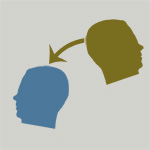
Lessons of Human Fusion

The story of Jerry and May (“Coed”) should give pause to anyone who invests all his or her self-concern in psychological continuity and connectedness.

To summarize the plot: Jerry, a 40-year-old neuroscientist, is diagnosed with devastating rapid-onset dementia, a prospect which he regards as equivalent to death.  To save himself, he hits on the plan of copying his psychological attributes to the brain of a graduate student, a young woman named May.  The copying process ‘reads’ his brain-states and ‘writes’ them to her brain, effectively reproducing his memories, abilities, personality, and other psychological dispositions.

Sticklers would regard this as a breach of academic ethics.  But Jerry, although manifestly self-centred, is not without a conscience.  The process he employs does not damage May’s psychology; instead, it takes advantage of redundant capacity in her brain to add his psychological attributes to her own.

Before the mental merger takes place, Jerry sees transference of his psychological attributes to May as a way to escape the fate of his disease.   He anticipates having a future in May’s body, which he expects to share with May herself.

The procedure works according to plan.  When they wake up, the personalities of both May and Jerry are recognizably present in May’s body.  All is not smooth sailing – May and Jerry find themselves in competition for motor control of a single body.  In order to act effectively, they must cooperate.  Sometimes the best way is for one to sit back passively and ‘let the other drive.’

But it is not an equal relationship – Jerry is at a distinct disadvantage.  May is at home in her body, and perfectly competent to manage it, but Jerry finds it foreign and difficult.  When he planned his transformation, he failed to anticipate the full impact of the physical dissimilarity it entailed: the sex change, the reduced physical stature, the girlish voice, loss of the gravitas that society concedes to the mature.  With May’s body, Jerry is more awkward than a pubescent teen. Continue reading “Lessons of Human Fusion”


The Plastic Self

Neurologists have demonstrated plasticity in the spatial sense of self, or body-image.  Not only are the ‘phantom limbs’ of amputees somewhat malleable, under special circumstances (and also remarkably intractable under others), but we can be induced to perceive a detached rubber hand, lying on a table, as our own hand, and even to feel that the table-top itself is part of our own body.  But how plastic, if at all, are our ideas of ourselves extended into the future and the past?

Published in 1970, Bernard Williams’ “The Self and the Future” is one of the seminal papers that gave rise to the contemporary philosophical debate on personal identity.   Williams presents two series of thought-experiments, which lead his own intuitions in opposite directions on the question whether a future person, described as having a certain relationship to his present self, would be himself or someone else.  One set of cases tends to persuade him that what matters in personal identity – the relation that makes us the same person over time – is psychological continuity.  The other set of cases makes him think that bodily continuity is more important.  Williams reports being left “not in the least clear” which is right.

Williams presents this as a philosophical problem.  I suggest it is more fruitfully regarded as an experimental result – a single data-point in a psychological experiment, with Williams as both subject and experimenter.  If repeated with a larger, and less contaminated, sample population, such an experiment could shed the light of empirical research on the question with which I opened this post.  I hope someone will undertake such a study, which could lead in interesting directions. Continue reading “The Plastic Self”

Phantom Self at the movies – Avatar

Phantom Self at the moviesAudiences of the movie Avatar are asked to accept that, by means of a vaguely-described technology, Jake Sully’s mind is transferred into the body of a blue-skinned, nine-foot native of the moon Pandora.  And they do accept it, with ease – even I, who consider myself attuned to issues of personal identity, bought the story without thinking about its strangeness until later.

The strange thing is that it’s not strange.  We have no trouble at all accepting that the able-bodied Pandoran is the paraplegic Marine.  Why?  Because the personality, memories, desires, and so on, of the human are transferred to the Pandoran.  There is no physical connection between the man, motionless in a pod, and the alien who is learning Pandoran ways; the two are linked only by the flow of information.   The fact that this does not bewilder viewers is strong evidence that they – we – regard this psychological connection as identity.  We follow Jake through interleaved episodes as human and Na’vi, convinced that it is one person’s story.

The movie can be seen as a giant psychological experiment on its audience, who might have reacted differently.  Continue reading “Phantom Self at the movies – Avatar”